
The Lactate Turn Point: The Bend in the Curve That Predicts How Long You Stay Strong

Breathing is the tell. Buffering lactate produces extra carbon dioxide, which is why the turn point is visible in ventilation, and why the talk test works as a field estimate.
Lactate has spent decades as the villain of exercise folklore. It is blamed for the burn, the soreness, the exhaustion, and it is written off as metabolic waste that must be flushed away. Almost every part of that story is wrong. Lactate is a fuel, produced constantly at rest, burned eagerly by the heart, the muscles and even the brain, and shuttled between tissues as a moving carbon account. The number that matters is not how much lactate you make. It is the exercise intensity at which your blood lactate stops drifting gently upward and starts turning steeply toward the sky, a bend known as the lactate turn point.
Lee C. Stonehouse programs the turn point as one of the central markers in the exercise tenet of the ten-tenet system, because it is the intensity dial that separates comfortable base work from threshold work, and because it moves with training at any age. He became a personal trainer at 21 in California after competing as a bodybuilder, and has spent decades watching what actually changes the trajectory of people whose fitness has quietly eroded across midlife. He wrote The Healthspan Extension Manual and built the 10-Tenet operating system behind it, and his own biological age was assessed at 47 against a chronological age of 63. His position on lactate is unfashionably calm: the molecule is a messenger, the bend in its curve is trainable, and the test does not require a laboratory.
Start with the founding science, because the rehabilitation of lactate is one of the quiet triumphs of modern exercise physiology. Tracer studies from the 1980s onward showed that lactate is produced continuously, even at rest, and that most of it is consumed again within minutes rather than accumulating. George Brooks and colleagues formalised the lactate shuttle: fast-twitch fibres and other glycolytic tissues release lactate, and slow-twitch fibres, the heart and the brain take it up and oxidise it for energy. Under this model lactate is less a toxin than a portable fuel link between tissues, a way of moving carbohydrate carbon from where it is produced to where it can be burned.
Breathing is the tell. Buffering lactate produces extra carbon dioxide, which is why ventilation bends upward at the same workloads where lactate turns.
The turn point matters for a reason most people never hear: it is visible in your breathing. When lactate accumulates faster than it can be cleared, the body buffers it with bicarbonate, and that buffering releases additional carbon dioxide above the metabolic rate. Ventilation must rise disproportionately to blow the extra CO2 off, and this is precisely why an exercise test that only measures breathing gas exchange can detect the lactate threshold without ever drawing blood. The famous gas-exchange methods of Beaver, Wasserman and Whipp formalised this in the 1980s, and the ventilatory threshold they detect tracks the lactate turn point closely in most people. Your breath is a lactate meter.
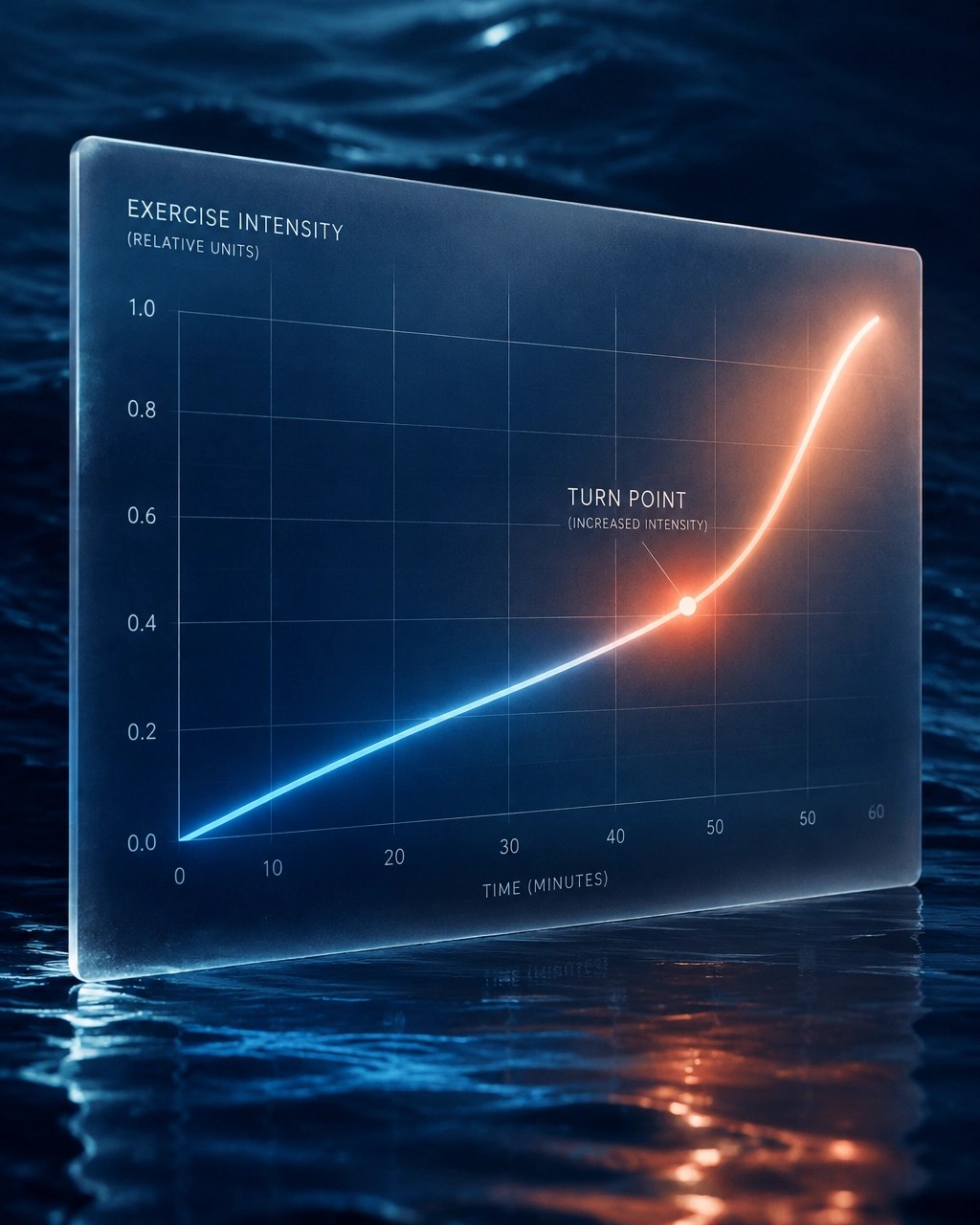
The turn point is the bend where buffering takes over, and it separates training zones more honestly than any formula based on age.
Why the turn point tracks VO2max and healthspan
The turn point and VO2max are two views of the same machinery. The workload at which lactate begins to turn is set by mitochondrial density and oxidative capacity in muscle, by the density of lactate transporters, and by how much of the heart’s output the working muscle can actually use. Those same qualities determine VO2max, which is why threshold measures and peak oxygen uptake correlate strongly and why both sit among the strongest predictors of long-term survival in observational cohorts. Reviews of lactate threshold concepts note that the point can be defined several ways, yet every reasonable definition improves on guessing. The person whose turn point sits at a higher fraction of their maximum can simply do more work before the system tips into debt, at any age.
There is a paradox hiding here worth naming. A trained athlete produces lactate copiously at high outputs and clears it just as fast, so lactate values at exhaustion can be higher in the very fit, not lower. Fitness is not low lactate production. Fitness is a high turn point, a faster clearance rate and a bigger oxidative base to burn the shuttle fuel. The molecule itself, as Gladden summarised in the new paradigm, is a signalling agent that even stimulates adaptations: rising lactate is part of the signal that remodels muscle toward greater oxidative capacity.

Mitochondrial density sets the turn point, which is why the boring accumulation of easy volume moves the bend more reliably than heroic intervals.
Training the bend: how the turn point actually moves
The turn point responds to a specific training signature. Large volumes of easy work below it expand the oxidative base and raise the density of mitochondria and lactate transporters, while smaller doses of work at and just around the bend teach the system to hold output there. Endurance researchers such as Seiler have described this distribution, roughly polarised in many successful programmes, across elite athletes for years, and the same architecture scales down to the over-forty reader. The dose is unfashionably boring: most of the week comfortably under the turn point, a small slice sitting just at it. Heroic daily moderate training, the spinning-class default, lands above the bend every session and leaves the base underbuilt while accumulating the fatigue that makes people quit.
Measuring the bend honestly matters as much as training it. In the clinic a lactate meter at defined stages gives the classic curve; at home the talk test is a surprisingly good field version, since the ventilation break that marks the threshold is also the point where conversation drops from full sentences to short phrases. Practical protocol: pick a steady modality, climb in small stages every few minutes, and note where speech quality shifts and breathing no longer settles. Retest the same way every eight to twelve weeks. The trend in that bend is one of the few fitness numbers that responds to training in its fifties, sixties and beyond.

The shuttle is the point: lactate moves carbon between fast fibres, slow fibres, heart and brain, and fitness is the machinery that burns it, not the absence of it.
A few honest cautions belong here. The turn point varies with testing protocol, modality and even carbohydrate availability, so trends require the same test repeated the same way. Beta-blockers and some medications flatten heart-rate responses and can distort zone formulas built from age alone, another reason the breathing-based read beats a formula. And the turn point is one window on capacity, not a diagnosis: joint health, strength and recovery metrics complete the picture that the exercise tenet reads as a whole.
The turn point sits naturally alongside the rest of the site: the VO2max after 40 article covers the headline capacity number itself, myokines and muscle as an endocrine organ covers the signalling side of trained muscle, and heart rate variability and vagal tone covers the recovery side of the same system. Threshold training is one input among the ten; the assessment is what tells a person whether their inputs are working.
For readers within a 10 mile radius of Brighton & Hove city centre, the turn point is tested and tracked as part of the structured exercise programming, with zone prescription set from measured data rather than from an age-predicted formula, and progress re-read in the trend lines every couple of months.
Find your bend with the talk test. Steady modality, small stages, and the point where full sentences become short phrases is a workable field estimate of the turn point. Note the workload or pace, not a feeling.
Spend most of the week under it. The base that raises mitochondrial density and lactate clearance is built below the bend, in volume that feels almost suspiciously easy. The small, sharp slice of work at the bend is the spice, not the meal.
Retest on a schedule, judge on trends. Same modality, same protocol, every eight to twelve weeks. A turn point that drifts upward across months is one of the few fitness numbers that keeps improving in midlife, and it is the one the heart and lungs report directly.
Lactate was never the villain. It is the fuel that links fast fibres to slow fibres, muscle to heart, and body to brain, and the bend in its curve is a live readout of the oxidative machinery that predicts how long and how well that machinery serves you. Find the bend, train under it more often than feels impressive, visit it deliberately in small doses, and retest. The boring protocol is the one that moves the number.
None of it is a guarantee. All of it beats guessing.
To make healthspan measurable, contact Lee directly on WhatsApp by text, voice note or voice call.
FREQUENTLY ASKED QUESTIONS
Does the lactate turn point really show up without a blood test?
Yes, indirectly. Buffering accumulating lactate releases extra carbon dioxide, which forces ventilation to rise disproportionately. Gas-exchange tests detect this ventilatory break and track the lactate turn point closely in most people, which is why breathing pattern and the talk test work as field estimates.
Is lactate the cause of muscle soreness after hard exercise?
No. Blood lactate falls back toward rest within an hour of stopping, while soreness peaks one to two days later and reflects connective tissue and inflammatory processes, not the molecule. The burn during effort is related to acidity, but next-day soreness is a different story entirely.
How do I train to move the turn point?
Spend most of your weekly volume comfortably below the bend, where conversation is easy, to build mitochondrial density and clearance capacity. Add a small slice of work at the bend itself. Most people overdo the middle zone and underbuild the base, which is the main fixable error.
Why does my turn point matter if I already train regularly?
Because regular training does not guarantee the right distribution. Many regulars sit above the bend nearly every session, which accumulates fatigue while the oxidative base stalls. Finding the bend lets you split the week honestly, and the upward trend in the bend is what predicts capacity.
Is a higher lactate reading after a test good or bad?
Neither on its own. Very fit athletes often show high peak lactate because they produce and clear it rapidly. The number that matters is the workload at which the curve turns, not the peak value at exhaustion, which is why the same test repeated the same way is the honest read.
- Gladden LB. Lactate metabolism: a new paradigm for the third millennium. Journal of Physiology. 2004 (lactate as a continuously produced, rapidly consumed fuel and signalling molecule, the lactate shuttle framework).
- Brooks GA. Cell-cell and intracellular lactate shuttles. Journal of Physiology. 2009 (lactate produced in glycolytic fibres is oxidised in slow-twitch fibres, heart and brain, linking tissues as a portable carbon fuel).
- Beaver WL, Wasserman K, Whipp BJ. A new method for detecting anaerobic threshold by gas exchange. Journal of Applied Physiology. 1986 (the ventilatory equivalents method for detecting the threshold without blood sampling, tracking the lactate turn point).
- Faude O, Kindermann W, Meyer T. Lactate threshold concepts: how valid are they? Sports Medicine. 2009 (review of threshold definitions, their validity, inter-individual variability and the dependence on testing protocol).
- Seiler S. What is best practice for training intensity and duration distribution in endurance athletes? International Journal of Sports Physiology and Performance. 2010 (polarised intensity distribution, large easy volume with a small threshold slice, as the architecture that moves the bend).
- Mandsager K et al. Association of cardiorespiratory fitness with long-term mortality among adults undergoing exercise treadmill testing. JAMA Network Open. 2018 (cardiorespiratory fitness, the system the turn point reads, as a strong predictor of long-term survival with no upper ceiling to the benefit).